



HOA board of directors vs officers: who actually does what
Written by: Christine Ponce
Published on: September 15, 2026
If you sit on an HOA board, you’re one of roughly 2,555,000 Americans who hold elected board seats or appointed committee spots in community associations. You steer 373,000 associations and collect about $124.2 billion in assessments annually.
With that much money and authority in neighbors’ hands, you need to know exactly who is allowed to do what. And one question trips up new volunteers: what’s the difference between a director and an officer? The two blur because the same people usually wear both hats, but the law treats them as separate roles. Once you know which hat you’re wearing at any given moment, you’ll make cleaner decisions and protect yourself along the way.
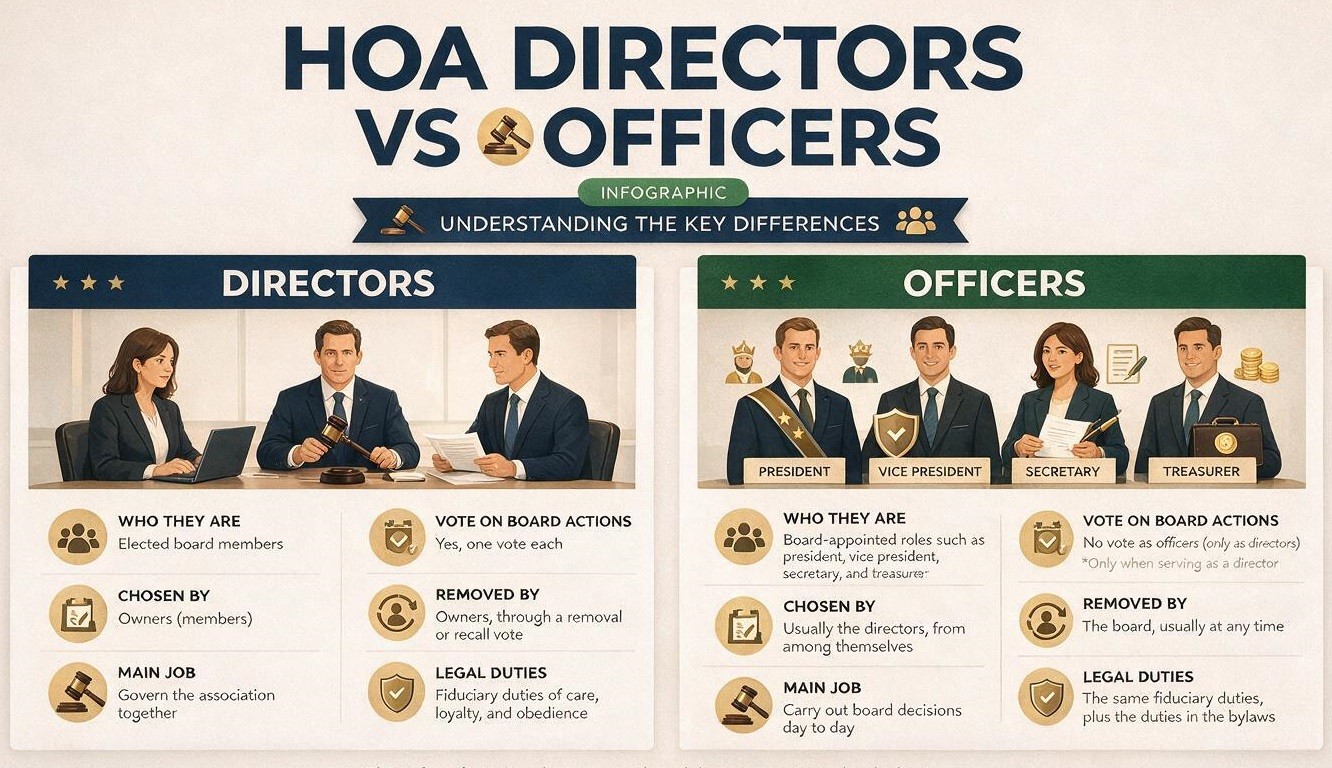
Let’s start with what each role does. Directors govern as a group. The law places an association’s activities and corporate powers with the board, or under its direction, and a board can act for the association in all matters unless the law, declaration, or bylaws say otherwise. Officers carry out what the board decides, running daily operations under its direction. Voting follows the same split. Directors vote on board actions, and officers don’t. So if you hold three offices, you still get one vote.
Then look at how each role gets filled. Owners elect directors, and the directors choose officers from among themselves. Both roles also carry legal weight. For example, in Florida, the statute treats directors and officers alike as fiduciaries to the members they serve. In this guide, I’ll walk you through the HOA board of directors vs officers, and show you what actually does what. Here’s a quick side-by-side first, and then we’ll begin with the board, since every officer’s authority flows from it.
Directors vs. officers: quick comparison
What the board of directors does: HOA board roles and responsibilities
Here’s the most important thing to remember: the board as a whole governs the association, not any one director or officer. Nobody can act alone unless the board has specifically delegated that authority. Decisions need a majority of a quorum, and individual directors can’t give orders to, or discipline, association employees. Here are the core HOA board of directors duties, also known as the duties of HOA board members or the homeowner association board of directors responsibilities:

Adopt and enforce the rules
The board adopts and enforces rules on the upkeep, repair, and appearance of common elements, plus anything else the declaration allows, including rules on collecting overdue assessments. In states like California, operating rules don’t need a member vote, while changes to the recorded CC&Rs do. An amendment needs approval from the share of members the CC&Rs specify, or a majority of all members if they say nothing.
That means the board has authority to adopt rules (as long as it’s in writing, within the board’s authority, consistent with the law and your documents, adopted in good faith through the right process, and reasonable). California’s process means giving members general notice at least 28 days before a rule change, then deciding at a board meeting after you’ve considered their comments.
Set the budget and the assessments
That $124.2 billion in assessments pays for management, utilities, security, insurance, common-area upkeep and amenities, and your board decides how much to ask owners to contribute. But keep in mind that the process the board has to follow to do this depends on the state. For example, in California, you must send out the annual budget report 30 to 90 days before the fiscal year ends, and a board-approved assessment increase is void if you skip that step.
Without a member vote, a California board also can’t raise regular assessments more than 20% over the prior year, or levy special assessments that total more than 5% of budgeted gross expenses.
Own the reserve policy
It’s the duty of the board to save up for roofs, street resurfacing, pool repairs, elevators and the like. Again, requirements on reserve study, how much to save and how to handle reserve funds vary by state, so the board doesn’t have limitless freedom on this decision. For example, California requires a reserve study, with a visual inspection of major components, at least every three years, and the board reviews it every year and adjusts as needed.
Hire and oversee the manager and vendors
The industry includes an estimated 60,000 to 65,000 CAMs and 9,000 to 10,000 management companies, but hiring a manager doesn’t hand off your job. California lets you delegate management to a person, a company, or a committee, as long as the association stays under your ultimate direction. A managing agent acts as the association’s agent, and some board duties can’t be delegated at all.
That said, for professionally managed communities, it’s the work of the board to hire managers, who in turn vet and recommend vendors. And for self-managed communities, boards vet and hire vendors directly. Again, the process is guided by state laws. For instance, Florida requires an HOA to get competitive bids on any contract costing more than 10% of its total annual budget, reserves included. For condominiums and cooperatives, the threshold drops to 5%.
Hear violations and appeals
The board is the rules enforcer, so it hears violations. But again, the process is guided by state law. For instance, in California, you must give at least 10 days’ written notice before a disciplinary meeting, and the member can attend and speak to the board in executive session if they ask.
You can’t discipline a member who fixes the problem before the hearing, and you must issue a written decision within 14 days. If the board and owner still disagree afterward, the owner can request internal dispute resolution.
Florida works differently. A fine or suspension needs approval after a hearing, with at least 14 days’ written notice, before a committee of at least three members appointed by the board. None of them can be an officer, director, or employee, or a close relative of one. If the committee says no, the fine or suspension can’t go forward.
Run the HOA board of directors meeting
The board acts at a properly noticed meeting with a quorum. Many states require boards to notify owners and let them attend open sessions, while allowing closed executive sessions for topics like litigation, personnel, and discipline. Check your state’s open-meeting rules.
Appoint officers and committees
The board chooses the officers (more on that below) and sets up committees, within limits. And again, there are state limitations. For example, in California, a committee that exercises board authority must include at least two directors, while advisory committees can include non-directors. Some powers, like filling board vacancies or amending bylaws, can’t go to a committee at all. HOA committee roles and responsibilities depend on what the board delegates. Common examples include architectural review, landscaping, and social committees.
Your legal duties as a director: HOA board of directors fiduciary responsibility
Being a director means you hold power on behalf of your neighbors, not for yourself. That means directors and officers owe a fiduciary duty to the members they serve. Attorneys usually break that duty into three parts: care, loyalty, and obedience.
- Duty of care: You must act in good faith, in a way you honestly believe serves the association, and with the care a sensible person would use in your seat, including asking reasonable questions before you vote. HOA board of directors training helps here, and some states require new directors to complete training or certify that they’ve read the governing documents.
- Duty of loyalty: Loyalty means the association comes before your own interests. Disclose any activity that could reasonably look like a conflict before the board votes on it or signs the contract. A typical HOA board of directors conflict of interest involves hiring a company owned by a director or a director’s relative. And as the interested director, step out of the discussion and the vote.
- Duty of obedience: You’re expected to follow your governing documents and state law, and to enforce them the same way for every owner. Acting beyond the powers your documents give you is ultra vires, and it can leave you personally exposed.
HOA directors and officers insurance
Directors and officers (D&O) insurance protects the people who run the association. Board members can be sued, and even when HOA board members are sued and win, legal fees add up fast. D&O coverage typically pays defense costs and settlements for covered claims, such as an alleged breach of duty or failure to follow the governing documents. It usually excludes fraud and other intentional wrongdoing. Condo association directors and officers insurance works the same way, and condo directors and officers insurance may be required by your declaration, state law, or a lender. Confirm what yours requires, ask whether volunteers and committee members are covered, and read the exclusions.
What officers do: HOA officer positions and duties
Officers are the board’s agents. They hold no governing power of their own, and the board appoints them and can replace them. Internally, your bylaws set HOA officer duties, including what an officer may actually sign. Externally, though, the association can still be bound by a contract an officer signs.
For example, in California, a document signed by the chair, president, or a vice president, plus the secretary, an assistant secretary, the chief financial officer, or an assistant treasurer, can’t be thrown out for lack of signing authority unless the other side actually knew about it. So choose who fills your HOA board positions with care.
President: HOA president duties
What is an HOA president? The president (or the board chair, if there’s no president) serves as general manager and chief executive unless your documents say otherwise. That means running day-to-day activities and speaking for the association when you deal with outsiders.
Other HOA president duties usually include presiding over board meetings and signing documents the board has authorized. Homeowners association president duties and condo board president responsibilities look much the same. But the title doesn’t make you the boss. One California HOA attorney puts it simply: presidents usually hold little power, because the board makes the decisions.
Vice president: HOA vice president duties
The HOA vice president steps in when the president is out. That backup role is the core of HOA vice president duties, along with any tasks the board assigns. If you have several vice presidents, have your bylaws say who takes over first. And don’t assume the VP moves up automatically. In most cases, the presidency doesn’t pass to the VP when the president resigns or is removed. The board may pick someone else.
Secretary: what does an HOA secretary do?
The secretary is your record keeper. Colorado’s nonprofit law, like others modeled on the national nonprofit act, requires the bylaws or the board to assign someone, usually the secretary, to prepare, keep, and certify minutes and other required records. The job also includes sending meeting notices and drafting agendas for the president.
Treasurer: what does an HOA treasurer do?
The treasurer looks after the association’s money, investments and financial records. Keep in mind that the power limits depend on state laws. For example, in California, the treasurer serves as chief financial officer unless your articles or bylaws say otherwise and you have a separate CFO.
You don’t need to be an accountant, and most treasurers lean on a management firm, accountant, or bookkeeper, but you do need to understand the numbers well enough to ask good questions.
Optional roles
Your documents can add more HOA board positions. For example, California allows a board chair in place of or alongside a president, plus any other officers your bylaws or board create. A director with no office (often called a member at large) serves on committees.
Can one person hold more than one office?
Often, yes, but you need to confirm with the state laws. For instance, in California, one person can hold any number of offices unless the articles or bylaws say otherwise, and Colorado’s nonprofit law says the same.
Washington allows multiple offices but won’t let one person be both president and secretary. North Carolina allows them too, but bars one person from acting in two roles when the action requires two or more officers.
That logic runs through California’s rules, too: the contract signing rule needs two signatures from two groups of officers, and reserve withdrawals need at least two people. A three-person board might have a president, a vice president, and a combined secretary/treasurer.
How each role is chosen, how long it lasts, and how it ends
Want a quick way to tell the two roles apart? Ask who gave each person the job. Members elect directors, and directors choose officers, and that two-step chain decides how long each person serves and who has the power to end it.
Directors
Directors get their seats from the membership. And that process is governed by state and community laws. For example, in California, director elections and removals must use a secret ballot, and every seat must go to a vote when its term expires and at least once every four years. Unless your bylaws say otherwise, a director keeps the seat until the term ends and a successor is elected.
HOA board of directors term limits depend on your documents and state law. For example, California briefly voided director term limits in 2019 and restored the right to have them in 2022.
If your association has a limit, you must disqualify any nominee who has hit it. Florida caps condominium directors at eight consecutive years unless two-thirds of the votes cast approve a longer stay or there aren’t enough eligible candidates.
How to remove an HOA board member
Since directors answer to the members, the members can remove them. In Florida, a majority of all the voting interests can recall a director with or without cause. Pay attention to that phrase: every eligible vote counts toward the majority, not just the ballots cast.
California also allows removal without cause. In associations with 50 or more members, removal takes a majority of the votes represented and voting at a meeting with a quorum, and that majority must also be a majority of the required quorum. Your bylaws can add another route: California’s Corporations Code allows removal of a director for missed meetings if the bylaws provide for it. If you’re asking how to remove a condo board member, check your state’s condominium statute and your declaration, because the process can differ from the HOA rules above.
Officers
Officers come from one level down. After the member vote, the new board holds its own vote to hand out positions, usually at an organizational meeting right after the annual meeting. In California, the board appoints officers who serve at its pleasure. Ohio requires an owners association’s board to pick its officers from its own ranks, with at least a president, secretary, and treasurer. Elsewhere, you get more flexibility, and if your documents allow it, you can name a non-member officer.
Officer terms follow the board’s calendar, not the members’. Many associations elect officers every year while staggering director terms. New York’s Business Corporation Law, which sets the default for many associations organized under it, has officers serve until the board meeting after the next annual shareholder meeting, and until a successor is chosen.
That wording hides a trap. People just voted onto the board might not be officers yet. Depending on your bylaws, if the board never holds that second vote, the previous officers can stay in power. So I suggest you put the officer election on the agenda for your first meeting after every election.
Removal is simpler for officers, too. Because they serve at the board’s pleasure, the board can change or remove them at any time, with or without cause, unless your documents say otherwise, subject to any rights the officer has under an employment contract. Unless your bylaws provide differently, a majority vote of the board fills a vacancy. And losing an office doesn’t cost anyone their board seat. That takes a separate process, usually a member vote.
Owners can’t remove officers directly, only directors. In Florida, owners recall directors, not officers, so if your members are unhappy with the president, their route is to recall that person as a director.
Frequently Asked Questions
What is a member at large in an HOA?
A member at large is a board member without an officer title. They vote like any other director and often take on projects or committee work. Among HOA board of directors positions, this one has the fewest set duties, so the bylaws or the board usually define the job.
Do HOA board of directors get paid?
Usually not. Most directors and officers serve as unpaid volunteers. Some governing documents allow expense reimbursement, and a few allow a stipend, but any pay must be authorized by your documents and state law.
Do homeowners association board members get paid?
Rarely. The same volunteer norm applies to officers, so the answer to “do HOA officers get paid” is usually no. Reimbursement for approved out-of-pocket costs is common, so check your documents and state law before accepting any compensation.
How many board members should an HOA have?
Your bylaws set the number. Many associations use three to seven directors, often an odd number so votes can’t tie. Some states set a minimum, so check yours before changing the size.
Do HOA board members pay dues?
Usually, yes. Directors are typically owners, so they owe regular and special assessments like everyone else unless your governing documents say otherwise.
Do HOA board members have to live in the community?
Not always. Bylaws usually require directors to be members in good standing, which generally means owners, and some also require residency. Check your bylaws and state law.
What are the HOA board of directors qualifications?
Typically, owning property in the community, being in good standing on assessments and rules, and meeting any age or residency requirements in your bylaws. Documents vary, so confirm yours.
How to become an HOA board member?
Confirm you meet the qualifications, watch for the nomination notice before the annual meeting, submit your candidacy by the deadline, and talk with your neighbors. Then, if you win, put the officer election on your first meeting’s agenda.
What are HOA board candidate statement examples?
Strong HOA board candidate statement examples are short: who you are, your priorities, and your commitment to the rules. For example: “I’ve lived here six years. I’ll focus on transparent budgeting and timely maintenance, and I’ll apply our rules fairly to every owner.”
Is HOA board of directors training required?
Not everywhere, but some states require training or a certification for new directors. Even where it’s optional, training helps you understand your duties and avoid costly mistakes.
What are the rules for HOA board members?
Board members must follow state law, the governing documents, and their fiduciary duties. Many boards also adopt an HOA board members code of conduct covering confidentiality, conflicts of interest, respectful behavior, and no acting alone.
What is an HOA board responsible for?
As a group, the board enforces the governing documents, sets budgets and assessments, maintains common areas, manages reserves, and oversees vendors. The responsibilities of HOA board members individually include attending meetings, reading the documents, avoiding conflicts, and acting in the association’s best interest.
How much power does an HOA president have?
Less than most people think. The president leads meetings and speaks for the association, but the board makes the decisions and the president acts under its direction.
Can the HOA president make decisions without consulting others?
Generally, no. Unless the board has delegated specific authority, major decisions need a board vote at a meeting with a quorum. Routine matters may fall within the president’s delegated authority, so check your bylaws.
Final thoughts
The difference in HOA board of directors vs officers comes down to these ideas. Directors govern together, and officers carry out what the board decides. Owners elect the directors, and the directors choose the officers. You can wear both hats, but they come with different rules for voting, removal, and duties. Know which hat you’re wearing, follow your documents and state laws on where your power starts and ends, and then perform your duties.